

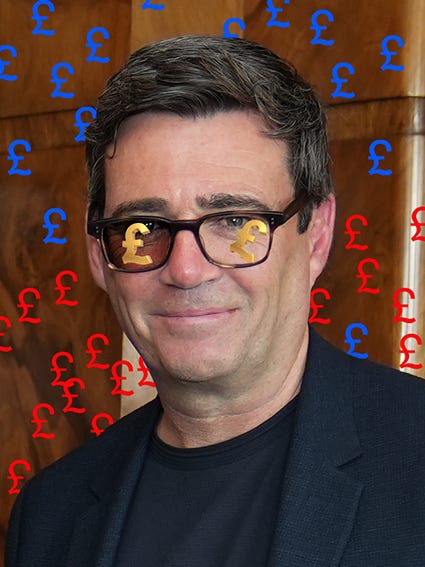
On 22 June 2026, Manchester United announced it had secured the majority of the land needed to build a new 100,000-seat stadium. The 25-acre site, located 350 metres north-west of Old Trafford, between Wharfside Way, Europa Way and John Gilbert Way, was purchased from Indurent, a UK warehouse landlord owned by the American private equity giant Blackstone Inc. The price was not disclosed at the time. The club's annual results later showed £63.5 million spent on stadium land, reportedly £60 million of it on this site. The deal was described as a "significant milestone."
On the same day, Andy Burnham left office, sworn in as an MP for Makerfield and standing down as Mayor of Greater Manchester. The BBC, reporting the land deal in a sports dispatch, noted the two events in the same breath without drawing the connection. Multiple sources told the BBC that only the government can now alter the multi-billion pound masterplan, regardless of which party Burnham’s successor as mayor comes from. That detail was reported and then left to stand without analysis.
The timing was not incidental. For nine years as Mayor of Greater Manchester, Burnham had been the primary architect of the institutional and regulatory framework that made the Old Trafford regeneration zone investable, and made Blackstone’s land, sitting inside it, enormously valuable. Now, as he pivots from city hall to Westminster and positions himself as the frontrunner to succeed Keir Starmer as Labour leader and Prime Minister, that structural relationship deserves examination.
This is a story about how democratic institutions are enlisted to de-risk private capital, and about a Labour politician whose “socialist” credentials are being burnished while the mechanisms he built hand windfall gains to a trillion-dollar asset manager with a documented record of labour abuses, data misuse, and environmental destruction.
The Zone
The Greater Manchester Investment Zone was announced by the then-Chancellor Jeremy Hunt in November 2023, as part of the Autumn Statement. It came with a £160 million state aid package from Whitehall, earmarked for infrastructure, skills, and “business support” over ten years. Its stated goal: to create 32,000 jobs in advanced manufacturing and materials, leveraging private investment into key development sites including Atom Valley and ID Manchester.
Burnham welcomed it without hesitation. “The Investment Zone will help us attract investment and create jobs and opportunities that will benefit people across Greater Manchester,” he said. “It’s also a vote of confidence in devolution and its ability to deliver levelling up.”
What he did not say, and what the mainstream commentary largely missed, was that this was a Labour mayor co-signing a Tory deregulation framework, embedding Greater Manchester into a national architecture of investment zones and freeports that Labour had officially opposed. Metro Mayor Steve Rotheram did the same in Liverpool, signing off on the Liverpool Freeport. Freeport and SEZ boards across the UK, from Teesside to Scotland’s Firth of Forth, included Labour MPs, councillors, Lords, and Baronesses alongside Tories. The pattern was consistent: public opposition, private participation.
Burnham’s Investment Zone was pitched as the softer version, no designated tax sites, no direct Freeport-style NICs relief or customs zones. But the £160 million state aid pot was real, the planning and development powers attached to GMCA were real, and the signal sent to private capital was unambiguous: Greater Manchester is open.
The Landlord
Blackstone did not need an invitation. It was already there.
In 2023, Blackstone completed the acquisition of a vast Greater Manchester industrial portfolio, approximately seven million square feet of warehouse and logistics space, including substantial holdings at Trafford Park. That portfolio was reported to be worth around £480 million. Through its portfolio company Indurent, formed from the merger of Industrials REIT and St. Modwen Logistics, both taken private by Blackstone, the firm became the dominant industrial landlord across one of the city-region’s most strategically significant areas, the world’s first purpose-built industrial park, sitting directly adjacent to what would become the Old Trafford regeneration zone. The specific Trafford Park portion of that portfolio was separately reported to have cost Blackstone between £275 million and £280 million. Manchester United have not confirmed whether the 25-acre site sold to them is the same land.
Blackstone is not a passive investor. As of 2024, it holds more than $1 trillion in total assets under management, making it the world’s largest alternative investment firm. BlackRock, now Starmer’s formal government partner, with 80% stakes in three UK Freeports, was itself launched inside Blackstone before spinning out as its own firm. The two companies share more than a naming convention: they share an ideological orientation towards asset acquisition, deregulation, and the monetisation of public infrastructure.
Blackstone’s record is worth stating plainly. The firm has faced legal action over illegal child labour in its supply chains; it settled for $19.6 million after disclosing Motel 6 guest lists to US Immigration and Customs Enforcement without a warrant; in 2020 it acquired a majority stake in Ancestry.com, bringing millions of people’s genetic data under its control. It has faced sustained criticism for its role in deforestation of the Amazon rainforest.
This is the company that was sitting on the land.
The Developer
While Blackstone was acquiring industrial land in Trafford Park, a parallel mechanism was operating in Manchester’s residential market, and it tells the same story from a different angle.
GMCA’s housing loan fund lent £140 million specifically to Renaker, owned by Daren Whitaker, under arrangements subsequently challenged in court, as part of a broader fund of around £940 million that has lent more than £500 million across its portfolio. The loans helped finance the skyscrapers that have redrawn Manchester’s skyline. A tribunal found that GMCA failed to obtain a statement of assets and liabilities from Whitaker before lending, exposing taxpayers to a risk the tribunal described as potentially wiping out the public funds entirely. A meeting between a senior GMCA officer and Whitaker at which loan terms appear to have been agreed produced no minutes or notes.
Court papers allege Renaker presented high profit figures to GMCA when seeking loans and low profit figures to Manchester City Council when seeking exemption from affordable homes requirements. Whitaker’s personal fortune grew from £140 million to £698 million during Burnham’s mayoralty. Almost all of the money was directed to central Manchester, serving the relatively affluent and offshore investors who bought apartments, with very little reaching the wider Greater Manchester area.
Rival developer Weis Group claimed in court that Renaker was given unfair preference by GMCA under post-Brexit anti-subsidy laws, the Subsidy Control Act 2022. The Court of Appeal dismissed Weis’s appeal in July 2026 and upheld the Tribunal’s finding that the loans reflected market terms and conferred no undue economic advantage on Renaker. The court explicitly ruled that even if process failures existed, including any failure to follow statutory guidance, the Competition Appeal Tribunal had no jurisdiction over those questions. This was a legal win for GMCA on the specific question of subsidy law. Whether statutory guidance was followed, and at what cost to taxpayers, remains a question the court was not asked to determine and did not answer.
The judgment nonetheless leaves the broader question unanswered. If the Subsidy Control Act cannot be used to challenge loans made to a developer who built a demonstrably low proportion of affordable homes from a £940 million public fund, the post-Brexit replacement for EU state aid rules offers even less protection than its critics feared.
The geographic dimension compounds the picture. The affordable housing didn’t materialise at the scale promised. And the constituency that received least from Burnham’s housing programme is Makerfield, the seat he now holds as an MP, and from which he is running to be Prime Minister.
This is not a separate story from the Investment Zone and the Blackstone land transfer. It is the same story in a different register. Public money, directed by mayoral authority, producing private gain, with the public receiving a fraction of what was promised. The mechanism is identical. Only the asset class changes.
The Corporation
In October 2025, Burnham took the decisive institutional step. He formally designated the area as a Mayoral Development Area and established the Old Trafford Regeneration Mayoral Development Corporation, the OTRMDC. In the language of the designation order, this was “expedient for furthering economic development and regeneration” in “one of Europe’s most significant investment and development opportunities.”
The MDC is a powerful instrument. It concentrates planning powers, land assembly functions, and development control into a single body overseen by the mayor. It strips out the friction that might otherwise slow private capital, competing local authority interests, community consultation timelines, conventional planning processes. In establishing the OTRMDC, Burnham did not merely endorse the Old Trafford regeneration. He built the machine that would deliver it, and in doing so, significantly enhanced the value of the land Blackstone/Indurent held inside the zone.
The MDC also holds compulsory purchase order powers. Those powers are now relevant beyond the Blackstone transaction. A second major asset manager, Brookfield, owns Freightliner, a rail freight company occupying land Manchester United also needs for the full stadium project. Brookfield is asking £400 million for that site. United values it at between £40 million and £50 million. Talks have deadlocked. The BBC reported in August 2025 that the OTRMDC could theoretically issue a CPO to resolve the impasse. So the public institution Burnham built may yet be used to compulsorily acquire land from one of the world’s largest alternative asset managers to clear the path for a project that will principally benefit a privately owned football club and its billionaire minority owner.
The public provides the mechanism. Private capital fights over the prize.
Eight months after the MDC was established, Indurent sold its land to Manchester United. The price is undisclosed. But the context is not. Burnham’s MDC provided the institutional certainty, the planning framework, the regeneration vision, the state backing, that transformed a Trafford Park industrial site into the anchor parcel for the UK’s largest sporting arena and a 370-acre regeneration project projected to add £7 billion annually to the UK economy. That certainty has a price. It was paid for by the public. The value accrued to Blackstone.
Multiple sources have told the BBC that only the government can now alter the masterplan, regardless of who succeeds Burnham as mayor. That is the lock-in stated plainly. Burnham built the architecture, stepped into Westminster on the same day the first land deal closed, and left behind a structure that is beyond local democratic reach. That is not an unintended consequence of zone governance. That is its design.
The Partners
The Investment Zone’s corporate entanglements did not stop with Blackstone’s land position. In December 2023, Burnham flew to Tokyo. There, at Fujitsu’s Shiodome City global headquarters, he and Manchester City Council leader Bev Craig signed an “exploratory partnership agreement” with the Japanese technology giant, explicitly linked to the development of Greater Manchester’s Investment Zone.
Burnham called it “a massive boost.” He posed for photographs next to the bullet train. He praised what he called Greater Manchester’s “most successful trade mission yet.”
The timing was extraordinary. The ITV drama Mr Bates vs The Post Office had just aired, exposing to a mass audience the scale of the Fujitsu Horizon scandal, the wrongful prosecution of over 900 sub-postmasters whose lives were destroyed by faulty Fujitsu software. Burnham had been vocal in his condemnation of that injustice, comparing the sub-postmasters’ treatment to the victims of Hillsborough and Grenfell.
He signed the deal anyway. When challenged, he said the partnership was signed “before some of the recent revelations had come through.” The statutory inquiry findings, he suggested, would inform any further decisions. No contract was signed. No public money was spent. The exploratory partnership drifted quietly into the background.
But the Fujitsu episode illuminates a consistent pattern in how Burnham approached the Investment Zone: corporate partners were welcomed, their reputations managed rather than scrutinised, their value to the zone’s narrative carefully curated. The £160 million pot was not just a subsidy programme. It was a signal, and Burnham was its most effective transmitter.
The Silence
On BBC Radio Manchester in January 2024, Burnham made a specific, public, on-the-record commitment: the fate of the Fujitsu partnership would be decided by the outcome of the Post Office public inquiry. That was not a vague aspiration. It was a conditional promise with a defined trigger.
The statutory inquiry concluded in December 2024. Its first report volume, published in July 2025, found that thirteen branch workers most probably committed suicide as a direct result of their treatment at the hands of the Post Office, a prosecution machine that ran on Fujitsu’s software, with Fujitsu’s knowledge, for years. The inquiry chair ordered Fujitsu and the government to publish a restorative justice plan by October 2025.
Burnham remained Mayor until 22 June 2026, eighteen months after the inquiry concluded. In that entire period, neither he nor GMCA made any public statement about the Fujitsu partnership’s fate. No announcement of cancellation. No confirmation it had proceeded. No explanation of what the inquiry’s findings meant for Greater Manchester’s relationship with the company. The partnership signed with such fanfare in Tokyo simply vanished from the public record.
This is not administrative oversight. Press offices do not accidentally forget to close the loop on something that generated national headlines and a direct mayoral commitment on live radio. The silence is a decision.
Freedom of Information requests submitted to GMCA have not clarified matters, they have deepened the questions. One request concerning a reported £15m Fujitsu contract for a digital inclusion pilot within the Investment Zone received a response that conflated it with the exploratory partnership, suggesting the two may be distinct arrangements. A second request, seeking correspondence between the Mayor’s office and central government departments on the Investment Zone’s designation, was killed by a clarification trap: GMCA asked the requester to define “central government departments,” then closed the request when no response arrived within the deadline. It is a technique. It works.
What is GMCA protecting? At minimum, the paper trail between Burnham’s office and Whitehall on how the Investment Zone was negotiated and designated. At maximum, evidence that the Fujitsu relationship continued, under a different contractual form, or simply unreported, after Burnham’s public promise to review it.
The question is simple. It has been eighteen months since the inquiry concluded. Andy Burnham said its findings would decide the partnership’s fate. What was the decision?
Burnham is now Prime Minister. The public is entitled to an answer.
The Hypocrisy Architecture
There is a version of this story that is purely structural, no bad actors, no conspiracy, just the logic of a system in which devolution deals are funded through corporate zone frameworks, and Labour mayors must choose between participating and being left behind. That version is not wrong. The pressure is real. The asymmetry between Manchester and, say, Edinburgh’s Forth Green Freeport, where firms inside the zone receive direct NICs relief, SDLT exemptions, and customs perks, creates competitive dynamics that are genuinely coercive.
But that version lets too much off the hook.
Burnham is not merely a victim of structural pressures. He is a political actor who championed these zones publicly, who flew to Tokyo to sign corporate partnership deals, who established the MDC that de-risked Blackstone’s land position, and who is now running for Labour leader on a platform of devolution, workers’ rights, and a “different kind of politics.”
The Labour Party, meanwhile, explicitly opposed Freeports in opposition. Shadow Chancellor John McDonnell called them “Thatcherite flops.” Yet Labour mayors, councillors, MPs, Lords, and Baronesses sat on freeport and SEZ boards throughout the Tory years, lending them cross-party legitimacy and operational depth. When Labour returned to government in 2024, it did not dismantle the zones. It kept all 12 Freeports and 74 SEZs, announced more in the October 2024 budget, and declared they would have “this government’s stamp.” Morgan McSweeney’s purge of the Labour left ensured there was no internal resistance.
The zones were never Tory. They were bipartisan from the beginning. The public opposition was the performance. The board memberships were the policy.
A question rarely asked is what made the post-2020 zone expansion possible at a scale the pre-2016 version could not have achieved. The answer is partly political, but it is also legal.
As the Institute for Government has noted, EU freeports were governed by the Union Customs Code and by EU rules on state aid, which stopped member states using selective tax exemptions and financial incentives to distort competition. The UK hosted seven freeports as an EU member between 1984 and 2012, and chose not to renew the legislation governing them, partly because EU constraints limited what those zones could offer to private capital.
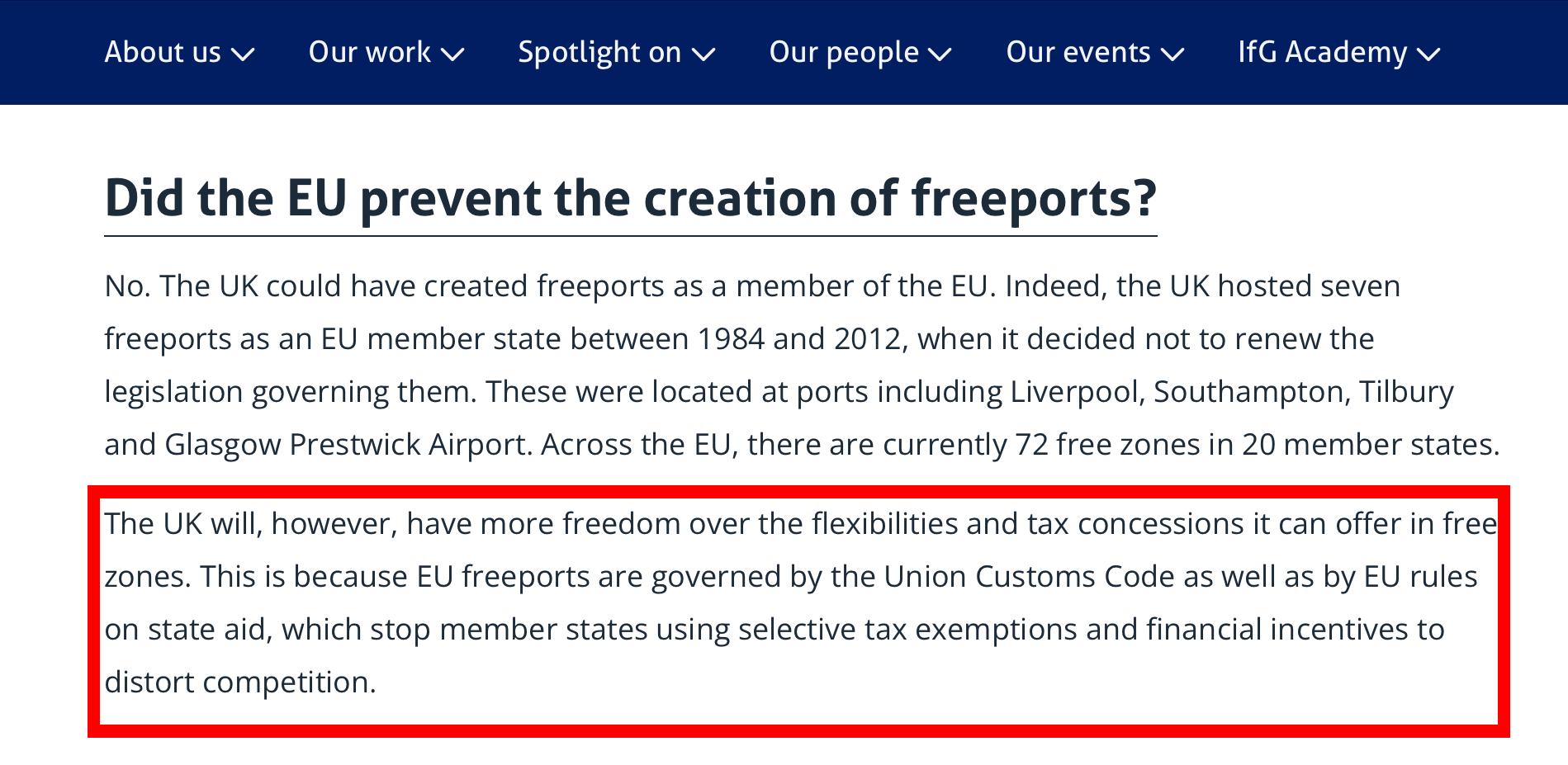
Brexit removed those constraints entirely. The UK’s replacement, the Subsidy Control Act 2022, is court-dependent and largely untested. Enforcement requires someone to bring a legal challenge, fund it, and see it through. The Renaker case, now ruled on by the Court of Appeal, was one of the first serious tests of whether it has any teeth. The Court of Appeal's July 2026 ruling, which found against Weis on the headline while confirming GMCA had failed to follow statutory guidance and cost taxpayers millions in lost interest, suggests the replacement framework has not filled the gap. The Teesworks deal, in which two local businessmen who invested nothing in the project are positioned to receive over £400 million from a publicly remediated former steelworks site, reinforces that conclusion.
The deeper question is why none of this was caught in real time. The answer is structural. The Audit Commission, established in 1983 to audit local government accounts and scrutinise the value for money of public spending, was abolished by the coalition government in 2015. In its place came a system in which private audit firms check the books, expensively and slowly. Just five out of 467 local government bodies had their 2022/23 accounts signed off on time. The firms now responsible for that audit work include the same Big Four consultancies, among them almost certainly Deloitte, that simultaneously analyse investment zone frameworks for government, advise businesses on how to benefit from them, and audit the local authorities that operate them. The conflict of interest is not incidental. It is the architecture of a system designed to move fast and audit slowly, if at all.
The EU state aid rules that once provided an external check on arrangements of this kind were removed by Brexit. The Subsidy Control Act 2022 that replaced them is court-dependent, requiring affected parties to fund their own litigation. Weis Group did. Most cannot. What remains as accountability infrastructure is FOI requests that get closed on technicalities, court cases that require deep pockets, and investigative journalism. That is an extraordinarily thin layer of scrutiny for decisions involving hundreds of millions of pounds of public money directed by a single mayoral authority with no minutes, no asset checks, and no external oversight body capable of catching it in real time.
Brexit was sold as taking back control. In the zone economy, what it did was remove the last external check on how public money flows to private capital. The 12 freeports, 74 SEZs, and growing number of AI Growth Zones that now cover the UK could not have been structured in their current form as EU member state zones. The constraints that once limited what private capital could extract from publicly designated areas no longer exist. What replaced them is a legal framework that requires affected parties to fund their own court cases to enforce it.
That is the legal infrastructure of the zone economy. It was not an accident of Brexit. It was one of its primary attractions for the people who designed the post-Brexit zone architecture, and who understood, correctly, that the removal of EU state aid oversight would make the UK the most permissive environment for this kind of public-to-private value transfer in Europe.
The Lobbying Infrastructure
In July 2026, Andy Burnham appointed James Purnell as his chief of staff. Purnell is the CEO of Flint Global, one of the UK’s most influential corporate lobbying and advisory firms, itself acquired by private equity giant Cinven in December 2025 for around £190 million. The firm that will sit at the heart of a Burnham government is not merely connected to corporate capital. It is owned by it.
Flint’s client list, which the firm refuses to publish in full in the UK, includes Uber, Amazon, BP, Airbnb, Microsoft, Apple, and Thames Water, the utility Burnham has publicly said should be nationalised. Its European arm was paid more than one million euros to lobby for Apple last year. Much of its UK activity falls below the threshold for statutory registration under the 2014 Lobbying Act, meaning Flint met officials from at least nine government departments on 38 occasions since Labour took office, including cabinet ministers Jonathan Reynolds, Douglas Alexander and Nick Thomas-Symonds, without being required to declare the majority of those meetings. The public has no way of knowing whether decisions that cross Purnell’s desk in Downing Street could benefit his former clients. Flint has not opted into the industry’s voluntary code of conduct that would require it to publish that list.
While at Flint, Purnell told corporate clients he hoped the government would be tackling regulations getting in the way of innovation, would avoid putting up taxes, and would concentrate instead on finding lower priority spend to cut back on. That is the stated policy position of Burnham’s most senior adviser, delivered to paying corporate clients before he entered Burnham’s office. It is also a precise description of what investment zone and freeport architecture does in practice: removes regulatory friction, avoids tax commitments, and redirects public spending toward private capital under the banner of growth.
Flint is not a Labour firm. It is not a Tory firm. It is a firm that has positioned itself across every available strand of British political life simultaneously. Its network includes Keir Starmer’s former chief of staff Sam White, hired to advise clients on how the Labour Party works in government and opposition. It includes Starmer’s economics adviser Rav Athwal, author of Labour’s 2024 manifesto. It includes former Labour home secretary Baroness Jacqui Smith and former Labour minister Siôn Simon. It includes former Rishi Sunak adviser Jean-André Prager, currently advising on disability benefits reform. Former Nigel Farage aide Leah Thornton said last year she was advising Flint. And Kiran Horwich, a Flint partner and one of its earliest employees, previously worked for the Liberal Democrats during the coalition government.
Labour. Conservative. Reform. Liberal Democrats. One lobbying firm, owned by private equity. Four parties, one corporate network, zero transparency on who its clients are or what it is asking government to do on their behalf.
The Green Party is not in that list. Zack Polanski, the Green Party leader, is on record demanding Flint publish its full client list following Purnell’s appointment. The Greens have consistently opposed freeports and Special Economic Zones as mechanisms for transferring public value to private capital, opposed the exploitation of post-Brexit state aid freedoms for private profit at the expense of public services, and opposed the deregulatory race to the bottom that zone architecture normalises. Their position is the coherent one. It is also the position with no seat at the table Flint has built.
That absence is as telling as every presence.
Polanski’s critique of the Purnell appointment was blunt: it seems it’s out with the old and in with the old. He called for full disclosure of Flint’s clients before Purnell takes up his role. Neither Burnham nor Purnell has committed to providing it. The public, whose money flows through the zone architecture this government will now be asked to expand nationally, remains in the dark about who has been paying the incoming chief of staff to shape the political environment in which those decisions are made.
The revolving door is not a metaphor. In the zone economy, it is load-bearing. The zones are the policy framework. Flint is the plumbing that connects corporate interests to the politicians who design and implement it, regardless of party, regardless of election result, regardless of what any of them say in public about workers’ rights, public ownership, or socialist values.
One detail closes the circle. Flint was acquired by Cinven, a private equity firm, for £190 million in December 2025. The lobbying firm now at the centre of Burnham’s operation is itself a private equity asset. The man who will be chief of staff in Downing Street ran a firm that corporate capital valued at £190 million precisely because of its access to political power. That access is now inside the building.
The Successor
Andy Burnham is now Prime Minister. He arrived in Downing Street on the strength of precisely the credentials his Manchester tenure is supposed to represent: the Bee Network, public transport reinvented, buses brought back under public control, a housing-first approach to rough sleeping, a northern voice in national politics.
These achievements are real. They should not be dismissed. But they exist alongside, not instead of, his role in building the zone architecture that handed a trillion-dollar private equity firm the institutional conditions to profit from publicly subsidised regeneration.
The OTRMDC published its draft masterplan on 9 July 2026. The details of the Indurent land sale remain undisclosed. The questions that should have been asked before he took office remain unanswered: what did the public receive in exchange for the £160 million of state aid and the planning framework Burnham built? How much did Blackstone receive for the land? What were the terms? Was any of the uplift value recaptured for the community?
These are no longer questions for a leadership candidate. They are questions for a Prime Minister who has appointed the CEO of a private equity owned lobbying firm as his chief of staff, who is expanding the zone architecture nationally, who is tailoring school curriculums to zone employer needs, devolving jobcentres to the mayors who oversee those zones, and making welfare conditional on taking the opportunities those employers define.
The logic of the Greater Manchester Investment Zone, public money de-risks, private capital profits, workers wait for jobs that may or may not materialise at the displacement rates the promoters never mention, is now the logic of national government.
Burnham built it in Manchester. He is implementing it across Britain.
The public paid for the architecture. It deserves to know what it bought.
Sources: Greater Manchester Combined Authority press releases; Bloomberg, Prolific North, Architects Journal, Construction Management (June 2026) on the Indurent land sale; BBC Sport (June 2026) on the land deal and MDC lock-in; BBC Sport (August 2025) on the Freightliner/Brookfield land dispute and CPO powers; UKTN and Yahoo News on the Fujitsu partnership; The Canary on Labour freeport board participation; Wikipedia on Andy Burnham and the New Trafford Stadium project; Computer Weekly and City AM on Fujitsu’s post-scandal contract record; Post Office Horizon IT Inquiry report vol. 1 (July 2025); FOI correspondence with GMCA (references 12197652 and 12701148).
More excellent research and warnings - for which I am grateful, and shocked that they are not apparently being picked up and investigated by MSM and politicians… or are they, and I am not seeing it? These details with their implicit and explicit questions of hypocrisy (or incompetence?) in relation to Burnham and other Metro Mayors - and the ‘Labour’ Government demand answers. Time for a Channel 4 special - doubt the BBC will help. But how to expose and derail these corrupt practices once and for all is a serious matter.
The yellow wind-farm jackets on the Leith foreshore feel symbolic because they make visible something that is usually hidden inside modern infrastructure: the gap between where projects are celebrated and where they are actually made.
Scotland is invited to see projects like Inch Cape as part of a national future — green energy, industrial renewal, skilled jobs, a working waterfront brought back to life. And that is not false. Leith really is being reshaped by offshore wind. The port is handling enormous structures, attracting investment, and becoming part of a new energy landscape. People can literally see the change on the ground.
But the yellow jackets also reveal another truth. The transition is not simply local or national; it is built through long international supply chains. Just as the Queensferry Crossing unsettled assumptions about what counted as “Scottish” infrastructure, these foundations prompt the same question again. If the project is hailed here, financed through institutions here, and installed off our coast, but fabricated in China, what exactly does “our future” mean?
Perhaps the answer is that “our” has become layered. It means local jobs in handling, assembly, marine operations, and maintenance. It means public pride in visible transformation. But it does not necessarily mean local control over manufacturing, or even local capture of the highest-value industrial work.
That is why the jackets make such a bold statement. They are not only pieces of offshore wind infrastructure. They are monuments to a new economic model: green in purpose, global in production, and slightly ambiguous in ownership.
They promise renewal, but they also ask who benefits, who builds, and who merely hosts. In that sense, their presence in Leith is not just practical. It is political.